Hydrogen Did Not Come Back Quietly. It Came Back Because It Had To
FIOPO Intelligence
Rajendra Ghimire, PhD, MBA, April 23, 2026
Not long ago, the U.S. Department of Energy announced and awarded its Regional Clean Hydrogen Hubs. Hydrogen was positioned as a cornerstone of future energy infrastructure. Soon after, the conversation softened. Execution timelines stretched, capital slowed, and hydrogen moved out of the spotlight.
Then geopolitics intervened.
For a period, hydrogen felt like a concept waiting for its moment. A few years ago, it dominated strategy decks, policy discussions, and investor narratives. Then reality set in. Costs remained high. Infrastructure lagged. Markets shifted toward near term returns. Hydrogen moved from center stage to the background.
The past year has changed that dynamic.
Energy markets have been reminded that systems are only as secure as their weakest link. Instability in key regions, pressure on global shipping routes, and shifting alliances have made one thing clear. Dependence creates risk. Concentration creates risk. Fragility is expensive.
Hydrogen has returned to the conversation. This time it is framed as a strategic asset.
From a water and energy perspective, hydrogen has always addressed a deeper question. How do we build an energy system that is flexible, domestic, and resilient at scale?
The Department of Energy Hydrogen Hubs program reflects a structural commitment to that idea. The objective is to build regional ecosystems where hydrogen is produced, transported, and consumed within industrial clusters.
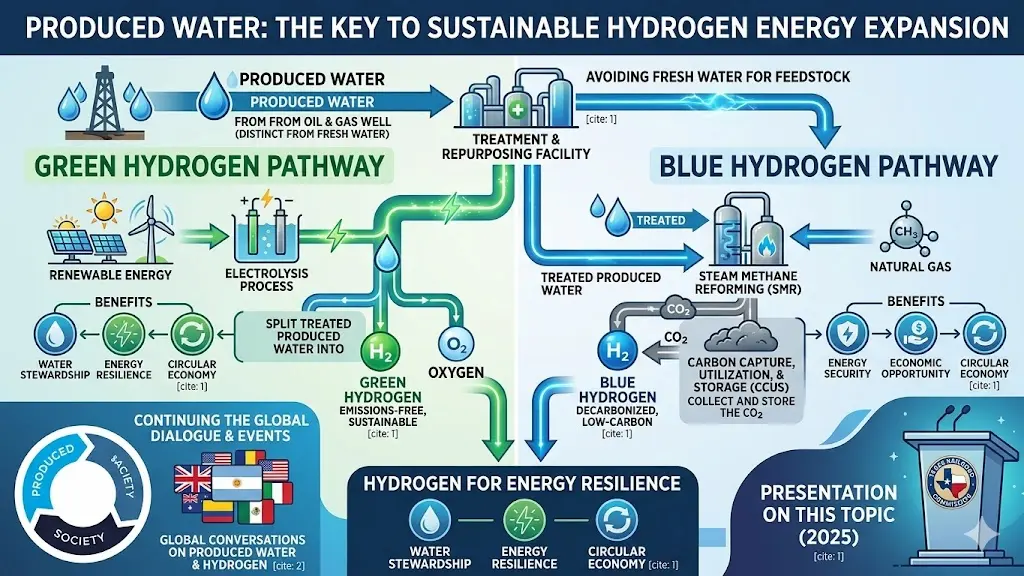
At the same time, federal efforts are exploring hydrogen generation from produced water. Oceanit is advancing plasma based systems to extract hydrogen from produced water streams. The University of Wyoming is integrating produced water desalination with hydrogen generation through thermal processes.
These efforts are early stage, but they signal direction.
Hydrogen requires water. At scale, hydrogen production competes with agriculture, municipalities, and industry for freshwater resources. This creates a structural constraint.
In basins such as the Permian, more than 20 million barrels of produced water are generated each day. Historically this water has been treated as waste and managed for disposal. That perspective is beginning to shift.
Produced water can be treated and repositioned as a resource. It can serve as feedstock for hydrogen production, support industrial cooling, and enable localized circular energy systems.
At scale, the numbers become difficult to ignore. Treating 10 million barrels of produced water per day and recovering 5 million barrels of desalinated water yields roughly 795 million liters of usable water daily. That volume can theoretically support the production of more than 88 million kilograms of hydrogen per day. At a price of 3 dollars per kilogram, this translates to approximately 265 million dollars in daily revenue, or nearly 100 billion dollars annually. Even after accounting for real world inefficiencies and system losses, the magnitude of the opportunity remains clear.
This is not about replacing existing hydrogen pathways. It is about expanding the system.
Energy resilience in this century will depend on integration. Water, power, fuels, and industrial demand must function as a coordinated system. Hydrogen sits at the center of this intersection.
What has changed is not the science. It is the urgency.
Hydrogen did not return because the narrative improved. It returned because the world became more complex.
In a more complex system, the ability to store energy, move energy, and reduce dependence on constrained resources becomes critical. That is where hydrogen operates. And increasingly, water is what enables it.
References
OilPrice.com – The Global Energy Crisis Is Reviving Green Hydrogen
https://oilprice.com/Alternative-Energy/Renewable-Energy/The-Global-Energy-Crisis-Is-Reviving-Green-Hydrogen.html
U.S. Department of Energy – Regional Clean Hydrogen Hubs
https://www.energy.gov/oced/regional-clean-hydrogen-hubs
U.S. Department of Energy – Hydrogen Program
https://www.hydrogen.energy.gov
U.S. Department of Energy – Clean Hydrogen Strategy and Roadmap
https://www.energy.gov/eere/fuelcells/us-national-clean-hydrogen-strategy-and-roadmap
U.S. Department of Energy – Hydrogen and Carbon Management FOA
https://www.energy.gov/fecm/hydrogen-and-carbon-management
Oceanit – Hydrogen Energy Earthshot and HALO
https://www.oceanit.com
University of Wyoming School of Energy Resources
https://www.uwyo.edu/ser
Texas Railroad Commission
https://www.rrc.texas.gov
Texas Railroad Commission Meetings and Agendas
https://www.rrc.texas.gov/about-us/meetings