Until now, most of us have steered away from the solid route, largely because of how large the volume could be. Rising salinity is a reason to look again, and the basin already moves solids at that scale.
By Rajendra Ghimire, PhD, MBA | @FIOPO Intelligence | October 2026
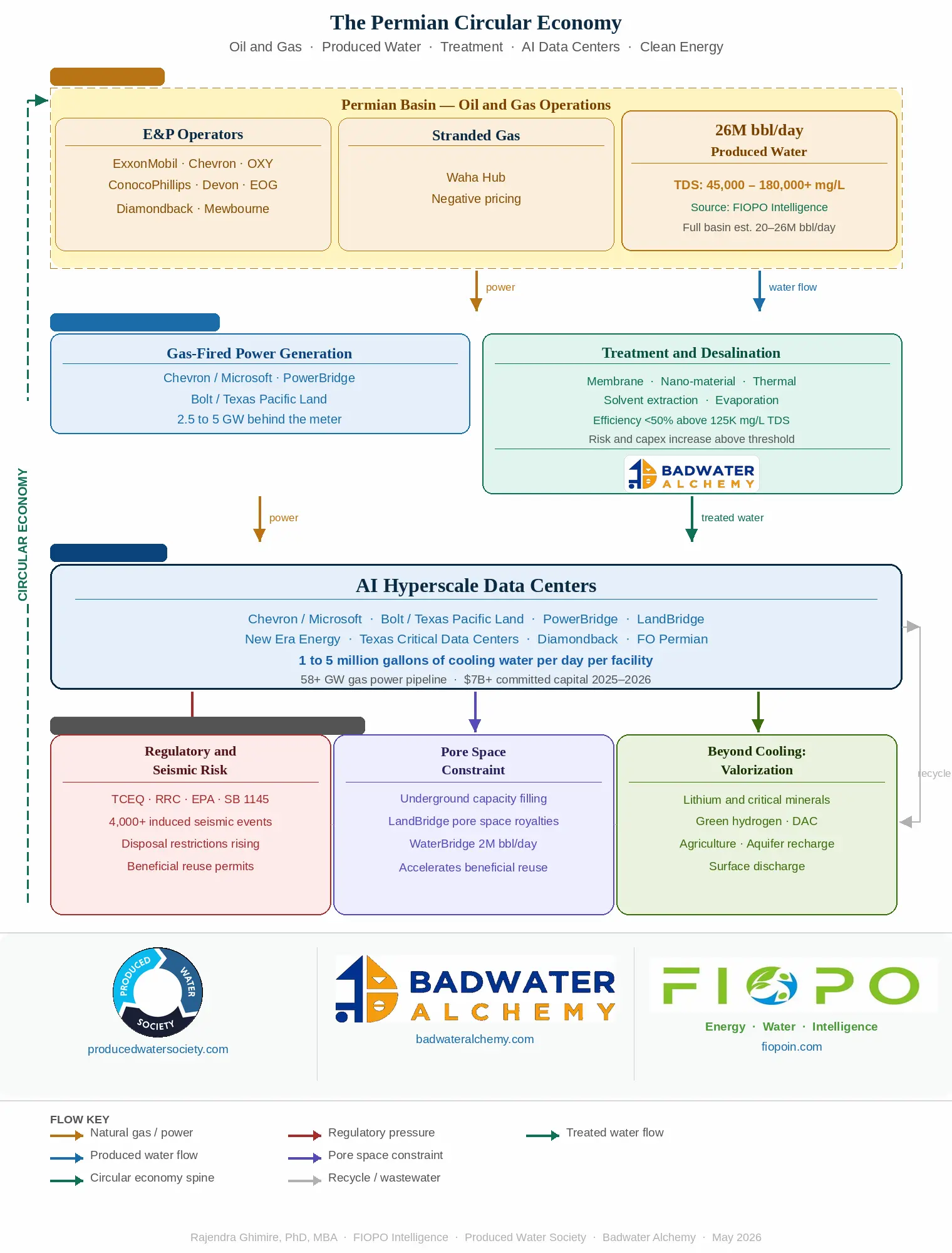
War closed the Strait of Hormuz in late February. Seven months later it is still not open to normal commercial traffic, and Brent trades near $103 a barrel against $66 a year ago. The barrels that matter most to the United States are the ones produced at home, and the largest source of them is the Permian Basin. The Permian’s limit is not geology or price. It is water, and the outlet for it is closing. The Railroad Commission of Texas tightened disposal permitting in 2025. Diamondback told investors in August of a moratorium on new disposal well permits imposed to control induced seismicity. Permian Resources calls water disposal its largest lease operating expense.
Here is the scenario I put on the screen in Midland in August, so we are all talking about the same thing. The Permian produces about 25 million barrels of water a day. Roughly 35 percent, 8.75 million barrels, is recycled into new completions. The other 65 percent, 16.25 million barrels, goes down disposal wells. Suppose the goal is to cut that injection in half. Permian water runs around 125,000 milligrams of dissolved solids per liter, and the plants operating today recover about half of what they take in. At 50 percent recovery, halving disposal means desalinating the entire disposal stream. Put 16.25 million barrels a day in. Get 8.13 million barrels of new water out. The other 8.13 million barrels leaves as concentrated brine and goes back to disposal. Every barrel of concentrated brine you make returns to the well.
That is the answer everyone prefers, because it stays liquid. Liquids move by pipe, and this industry knows pipes. The plants now running at Orla and near Red Bluff Reservoir both work this way. The trouble is chemistry. Concentrated brine tops out at about 250,000 milligrams per liter, the point where sodium chloride begins to fall out of solution. That ceiling fixes the yield. At a feed of 125,000, a plant recovers half the water. At 150,000 it recovers 40 percent. At 175,000, 30 percent. Above 125,000 you cannot halve disposal at all, however much plant you build, and parts of the Delaware Basin are already past it.
This is the salinity wall. As the water gets saltier, the concentrated brine path delivers less new water, sends more volume back underground and loses its economic case. That brings us to the route most of us have set aside until now: take the salt out as a solid. The hesitation is understandable. Whenever the conversation turns to solids, we start by picturing how large the volume could be, and it stops there. Some processes concentrate a brine first and then dry it. Others produce a solid byproduct as their normal output. Either way the salt leaves the water system, and no chemical ceiling limits how far that can go.
It will not arrive all at once. The Texas Commission on Environmental Quality has accepted discharge applications since 2024 and has issued no permit, but all three midstream applicants, Texas Pacific, Western Midstream and NGL, have now worked through a third draft with the agency. Take a plain scenario. All three receive permits and start at somewhere between 10,000 and 50,000 barrels a day each. Add the smaller initiatives, such as a 20,000 barrel a day project at Exxon Mobil. By the end of 2027 the Permian could be desalinating around 200,000 barrels a day, a little over 1 percent of the disposal stream. That produces 100,000 barrels a day of concentrated brine carrying about 88 pounds of salt per barrel: roughly 4,400 tons of salt a day, 1.6 million tons a year. At the halving target the figure is about 130 million tons a year.
Those numbers sound unmanageable until you look at what this basin already moves. Permian operators pump nearly 80 million tons of frac sand a year, up from 14 million in 2016, with 10,000 to 15,000 tons going into a single well. When trucks could no longer carry it sensibly, Atlas Energy Solutions spent $400 million on the Dune Express, a 42 mile electric conveyor from Kermit, Texas, into New Mexico that can move 13 million tons a year. Atlas compared it to the way pipelines replaced trucks for oil and water. Nobody subsidized it. It was built because the tonnage and the economics justified it. Salt is the same kind of problem. The first stage of desalination, by my scenario, makes about an eighth of what one Dune Express carries. The halving target makes ten Dune Expresses’ worth. An industry that handles sand at that scale can handle salt.
The question is what to do with it, and I do not think there is one answer. So let us start asking. Can the solids be converted into ceramic proppant and sent back down the wells they came from? Researchers have already sintered proppant from oil based drilling waste. Can they go into concrete and other construction materials? Can they be redissolved into a fortified brine with a market of its own? Can they be diluted into the disposal stream that already exists and sent downhole, adding little to its salinity? Where a landfill can be permitted nearby, is plain disposal the cheapest route?
What can be recovered first? About nine-tenths of the solid is sodium chloride, and the remainder holds lithium, magnesium, bromine and iodine. Liberty Stream is producing battery grade lithium carbonate from produced water in Howard County, and Select Water Solutions has signed an iodine extraction agreement. The right byproduct route will be specific to the area. What works beside a landfill in Reeves County may not work a hundred miles from one. Each option has to be judged on its economics, its logistics and the infrastructure already in the ground. We need to explore all of them, and we need to start now, while the volumes are still small enough to learn on.
Some capital already has. Water Bridge spent this summer buying a landfill and building a waste facility, not a desalination plant. The demand for the water is not in doubt. Texas has roughly 474 gigawatts of grid connection requests pending, about 90 percent of them data centers, and the governor has frozen their state permits until they disclose their water use. A single one gigawatt campus needs about 220,000 barrels of water a day. In West Texas, produced water is the only large source that does not come from towns and farms.
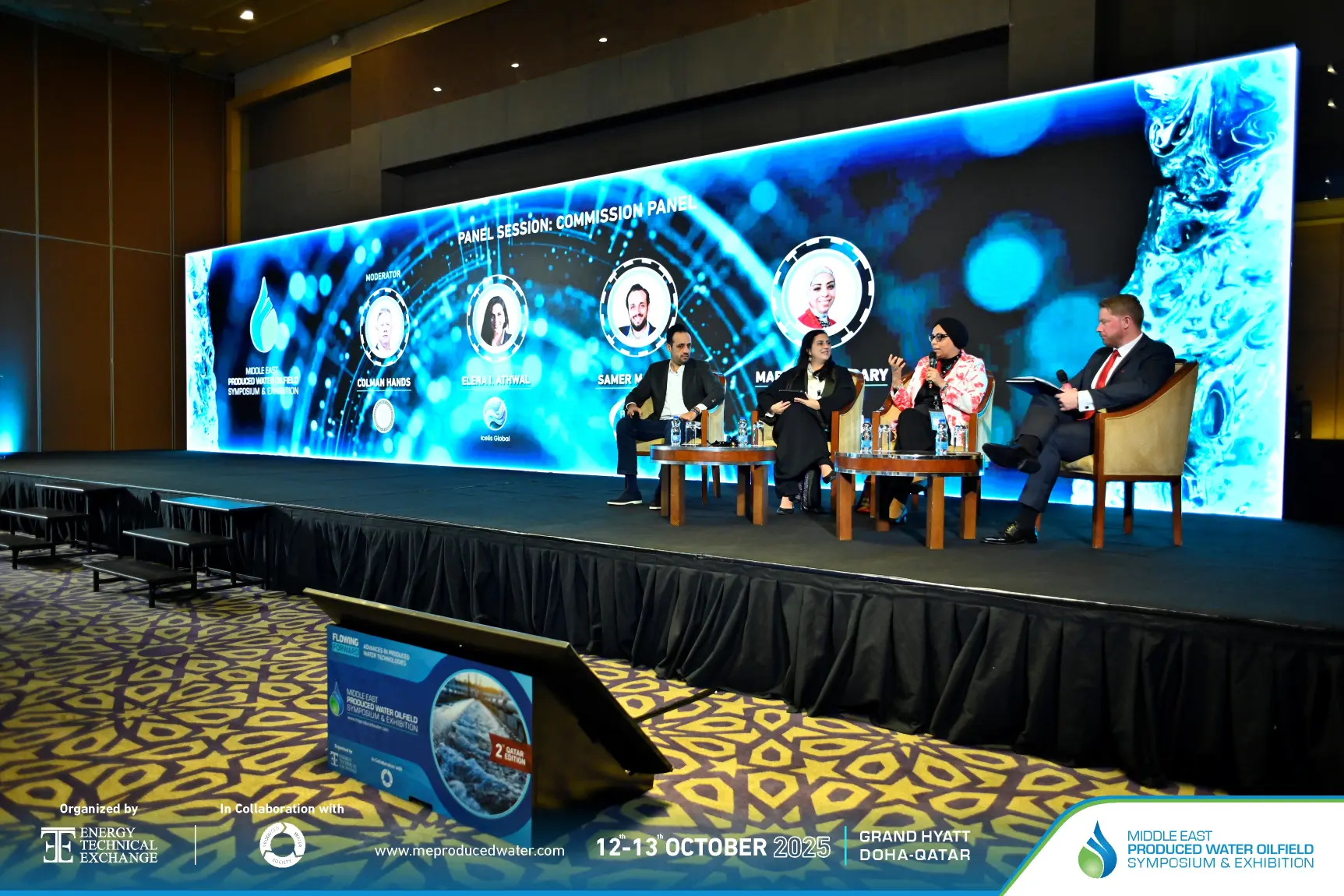
The solid route has not been the first choice so far, and the reason has been scale. The sand business shows that scale by itself is not the obstacle. Salinity is the variable to watch, and it is moving one way. The Produced Water Society will put these questions on the table twice in the United States in 2027. The 37th Annual Conference meets February 8 to 11 in Sugar Land, Texas. The 12th Annual Permian Basin Conference meets August 3 to 5 at the Bush Convention Center in Midland. Block both dates. The country’s energy security may be argued in the Gulf, but a good part of it will be settled in West Texas, one ton of salt at a time.
Rajendra Ghimire, PhD, MBA, is Vice President of the Produced Water Society and Vice President of Business Development at Bad water Alchemy, which is developing a desalination technology that produces a solid byproduct.

Submit an abstract: shikha@producedwatersociety.com
Register: producedwatersociety.com
Sponsor or exhibit: rghimire@producedwatersociety.com
Badwater Alchemy: badwateralchemy.com